
The window over your kitchen sink might be the one you’d open most often if it were easier to reach. A crank-out window could solve that. But if it opens over the steps to your deck, you’ll want to see where it swings before you order it.
When we’re helping someone choose replacement windows, we start with how they use each room. Stand where you’d normally open the window. Then step outside and see what’s around it. A deep counter, a porch railing, or a walkway can make one style a better fit than another, even when both would fit the opening.
Over a kitchen sink, check what you can reach
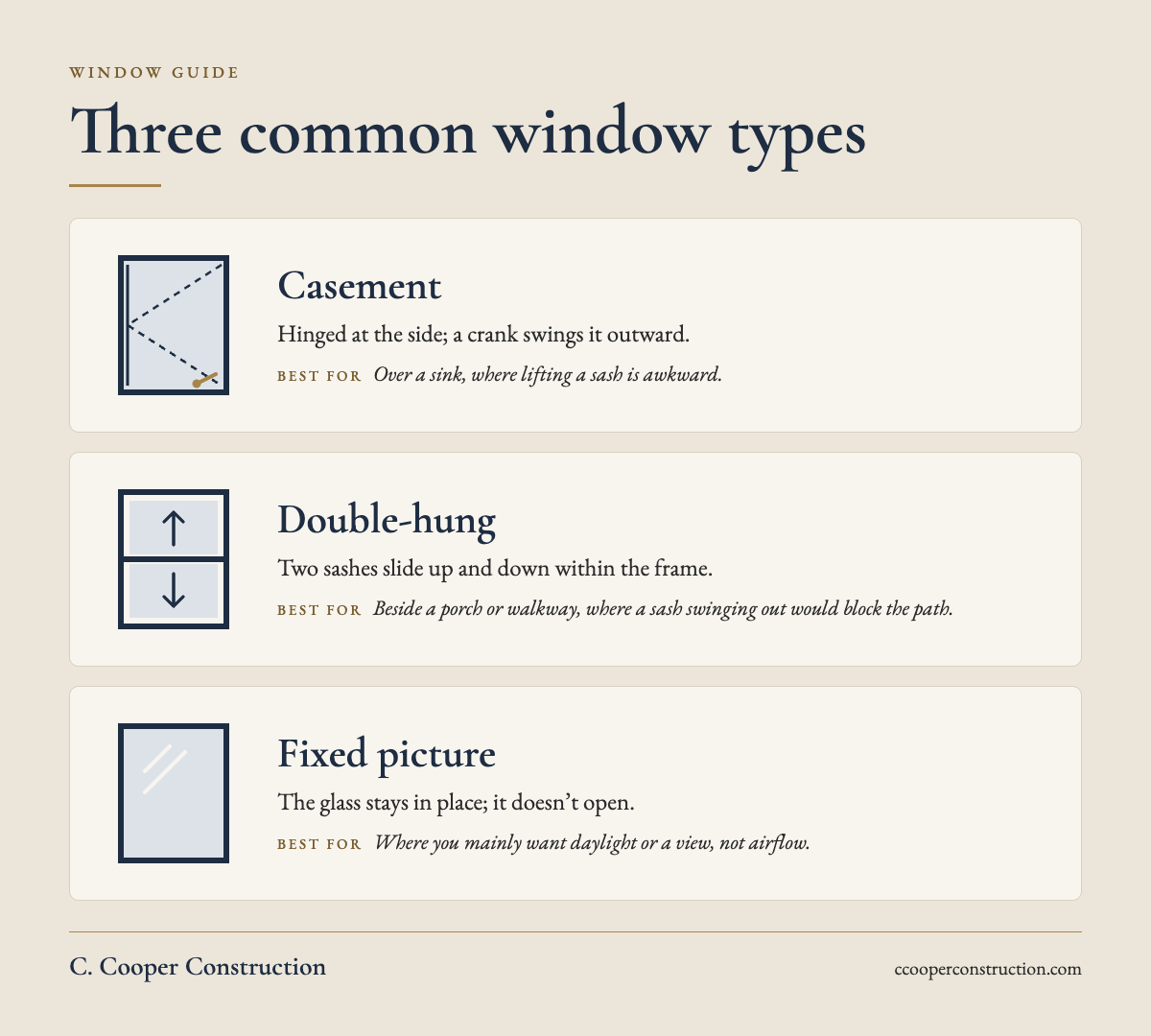
If you have to lean across the sink to lift your current window, a casement is worth considering. On a crank-operated model, the handle is usually near the bottom of the frame. Check where the lock sits, too. You’ll want to be able to reach both comfortably from where you stand.
Outside, look for anything that might be in the way of the open sash, such as a downspout, a nearby wall, or the route people take down the deck steps. If there’s more room on one side, ask your contractor to show you where the hinges would go and how far the window would project when open.
Beside a porch or walkway, leave room for people to pass
A double-hung window lets you open the top, the bottom, or both. The sashes move vertically within the frame, so you can let in fresh air while someone walks past on the porch.
It’s also worth thinking about how you’ll wash the outside glass, especially upstairs or above a porch roof. Some double-hung windows have sashes that tilt inward for cleaning. If that matters to you, ask to try the feature on the model you’re considering.
When a sliding or awning window makes sense
A sliding window opens sideways within the frame. It’s another option alongside a porch or walkway, especially if the existing opening is wider than it is tall. Ask which side opens so you can check whether that’s the side you’ll be able to reach.
An awning window hinges at the top and opens outward at the bottom. It’s worth considering for a wide, short opening where you’d like some fresh air. Like a casement, it needs room to swing outside. Check where the bottom edge will sit when it’s open, particularly if the window is near a path or porch seating.
Where you mainly want light or a view, consider fixed glass
Maybe it’s the morning light across the dining table or the view of the backyard from your favorite chair. If you already have a nearby window you like to open for fresh air, a fixed picture window can give you an uninterrupted view.
You can combine fixed and operable windows, too. In a wide living room opening, you might put a picture window in the center and a window that opens on one or both sides. Picture where the sofa, lamps, and side tables will sit before you decide which window you’ll open most often.
Before changing a bedroom window, ask your contractor whether it needs to serve as an emergency escape and rescue opening. If it does, have them verify the clear opening of the exact replacement model before ordering. Two windows that fit the same opening in the wall can leave different amounts of space to get through.
In an older home, look at the windows together
Walk out to the street and look at the front of the house. On a row of double-hung windows, notice where the horizontal bars between the upper and lower sashes line up. A casement can fit the same opening and still change the look of that row. If you’re considering a switch, ask to see a drawing of the proposed window alongside a photo of the house before you order.
If the original wood windows are still in place, have someone assess their condition first. A window that sticks or lets in a draft may be a candidate for repair or weatherstripping. If replacement makes sense, compare the proportions of the glass, the thickness of the sash, and how the new window will sit within the existing trim. Those details are easiest to see while the original is still in front of you.
A quick walk-through before you request a quote
For each window you’re considering, jot down three things.
What would I like to work better? Maybe you want to open it easily while you’re cooking, or clean the outside glass from indoors.
What would I miss if it changed? Think about the original trim, the view from the table, or the way it lines up with the other windows from the street.
What’s around it? Take one photo from inside and one from outside. Back up far enough to show the counter, furniture, porch steps, or anything else that affects how the window could open.
You can bring those notes to a quote appointment even if you haven’t settled on a window style. “I’d love to open this while I’m cooking, but it sits over the steps to the deck” gives us a place to start.
If you’re planning a window replacement project in Utica, New Hartford, Clinton, Hamilton, or elsewhere in Central New York, we’d be glad to help. Whether you’re looking for a kitchen window you can open without leaning across the sink or trying to keep the original trim in an older home, we can walk through your options with you and help you decide what’s worth keeping.